A year of chess
Some background
I wouldn't call myself a gamer. Most of all because I'm unable to relax enough to properly immerse myself into a game. But I do need something that will allow me to step away from whatever I'm doing and focus solely on that thing for about 30 minutes. A game of that nature allows me to do two things: refocus my mind by practising targeting my attention, and detect if I'm having a sharp or dull day (based on winning or losing streaks). It's also an escape hatch for when I feel like there's too much noise and I just need a break.
It has to be bite-sized that way, as I also have an addictive personality, and if I can't pace myself by limiting myself to one round or one match, I'm going to be stuck forever. I'm also pretty competitive, so I prefer something where I can measure up against others (if not by competing with them directly, then through some sort of leaderboard). Ideally, getting good at the game is skill-based and the skills are transferable in some way, rather than e.g. memorising game-specific trivia, so I don't feel like I'm wasting my time / brain power if I can convince myself that I'm growing.
Finally, there also needs to be an "end". I never had a problem with discipline and intrinsic motivation. I can easily play a game every day for the rest of my life if it has no end, because I'm too stubborn. So I need to actively draw the line at the start, and say "when I reach X milestone, I'll be done".
In my Starcraft phase, this was diamond league. In my Tetris phase, this was reaching platinum on tetrisfriends.com (which I managed to do in time before the website was shut down). These lines are arbitrary, but need to exist, and usually denote that I'm good enough to where I'll probably beat most people I come across.
My chess phase
I have of course casually played chess with friends and family growing up. I thought I was pretty good, compared to other casual players, simply by noticing when I was leaving pieces unprotected (which I later learned was called hanging a piece) and by trying to think some moves ahead.
Then my algorithm started pushing chess content on me. I was quite resistant to get into it at first, as it seemed like getting good at it meant studying a lot of theory, and that felt as "good" as scoring highly on an IQ test. I didn't want to fill my brain with random rules for an invented game.
I started watching these chess games for entertainment though, and thought I could get quite far simply by playing. I was not interested in studying theory, doing puzzles, or even learning the grid coordinates.
So I went on chess.com and simply started playing. I picked up the terms like a fork and a skewer by coincidence from mainly GothamChess going over yet another Magnus Carlsen game. It turns out that when someone asks you your ELO, they really mean your chess.com Rapid rating, which is what I mostly played. It also turns out that I was pretty bad.
Getting better
Like I said, I didn't want to study, I wanted this to be fun if possible. Often I would actually just get quite angry at a silly mistake. But more and more I also enjoyed when I did really well, and over time the silly mistakes were rarer, and when they happened I tried not to let them get to me.
Around the same time I started playing chess, I was having driving lessons. I spotted a lot of parallels with how I think while driving and how I think while playing chess, for examples when anticipating situations. I enjoyed learning patterns that I could delegate to my autopilot, so I can focus on the higher-level patterns and goal. These would be the equivalent of simply expressing intent to park your car, instead of having to think about how to move your feet. Similarly, you don't think about how to move an individual chess piece, but start thinking about higher-level strategy and tactics.
I really enjoyed that aspect, and found it meditative. Seeing these parallels might also just be confirmation bias however, as in my Tetris phase I started seeing falling blocks everywhere, and I found if difficult to read paragraphs where the lines didn't end with equal lengths, as I couldn't stop seeing the blocks falling into those corners.
With chess on the other hand, I found openings that I liked to play. I liked playing my queen's pawn to the center, so that's what I always did, no matter if I was black or white. Chess.com kept telling me that I was playing the Queen's Gambit (white) or the French Defence (black). Since the French Defence is less common (it's very cramped), it turns out that I'm statistically really good when I play that, probably because people are less prepared for it.
Over time I sort of reverse engineered the main lines, and I could see chess.com name them, e.g. the "advance variation". When they came up on YouTube, I inadvertently learned a bit more about them. All I was doing though was playing the same patterns I liked as both black and white.
Chess clubs
On chess.com it's rare that you play the same person more than once (unless they ask for a rematch). You can have friends that challenge you, but because that's sort of async, those tend to be slow daily games, not rapid. I tried dailies once or twice and really didn't like it. It's not fun when you have all the time in the world to think about your next move, and have to context switch, so I only play rapid or faster. Blitz is still ok, but my opponents usually run out of time, and it's not fun to win that way. Bullet is even worse in that regard -- I'd rather checkmate!
I thought it might be cool to see if understanding a single person's chess style can affect how you play chess. So I went to check out a chess club, early in my journey. It wasn't super close, but I had my car by then. I did not like it.
They met on top of this church, there was a fee, and everyone was extremely serious. They'd usually play classic, everything was silent, and they're noting all their moves on paper. The goal here was clearly tournaments.
I didn't feel all that welcome. When I arrived, there were an odd number of people. A teenager who arrived roughly around when I did was waiting for his scheduled opponent. While he was waiting, I asked if he'd be up for a quick game. I think we did 10+2 or something like that.
I must have been 400 or something at the time. I thought I was doing ok, but in general I was in a losing position pretty quickly. Then his opponent arrived and he started seeming a bit impatient, so rather than holding on I decided to just resign. He started his scheduled match with his opponent, and I left, never to return.
Later, I found a better, casual club on top of a pub. Sometimes a cat joins. You go in, get an armband to roughly signal your ELO, and then play casual matches with others. Everyone there was pretty nice, and they only ask that you maybe get a drink for the pub's sake.
I played a strong player (1100 I think) twice, though this was pretty early on as well. We were chatting through the games where I was first white, then black. I think this was the first indication that I was really good with the French, because while I lost the both games, I almost won the second, only to blunder towards the end. He did not believe that my ELO was 700 or whatever it was at the time.
Unfortunately, this club met on Tuesday evening, and then my gym class moved and clashed with it, so I stopped going.
A year later
I lied. It wasn't a year. My streak is 344 days, and I played at least one game every one of those days. There are a lot of websites where you can enter your chess.com username and it gives you your stats, but here's my chess.com graph.
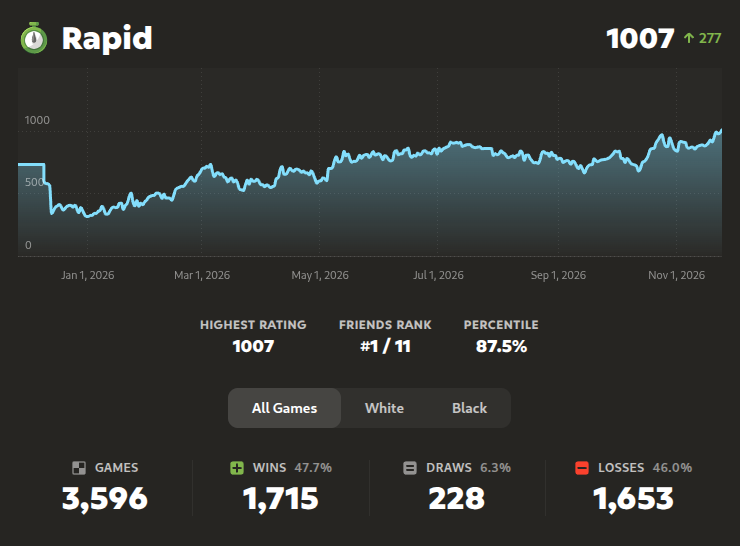
My bar was reaching ELO 1000, which is hard enough to where passing that means you're a strong player, but not so high that you would have to play for several years and eat theory books to progress. Now that I've passed 1000, I'm forced to stop no matter how much I have the itch to play a game. Those are the rules.
I may play random matches with real people in real life of course; this is not a rule that I can never play chess again, but I cannot do my chess.com climb anymore, or risk addiction. It's kind of nice that I managed to reach the goal in less than a year, though I didn't know how long it would take when I started.
My journey was punctuated by winning streaks and losing streaks especially in the final third, I think also because I turned off the setting where you get matched to people that are close to you in ELO, so I started getting players that were far above me.
Realistically, I might be higher than 1000 by now, as these are the stats by opponent ELO:
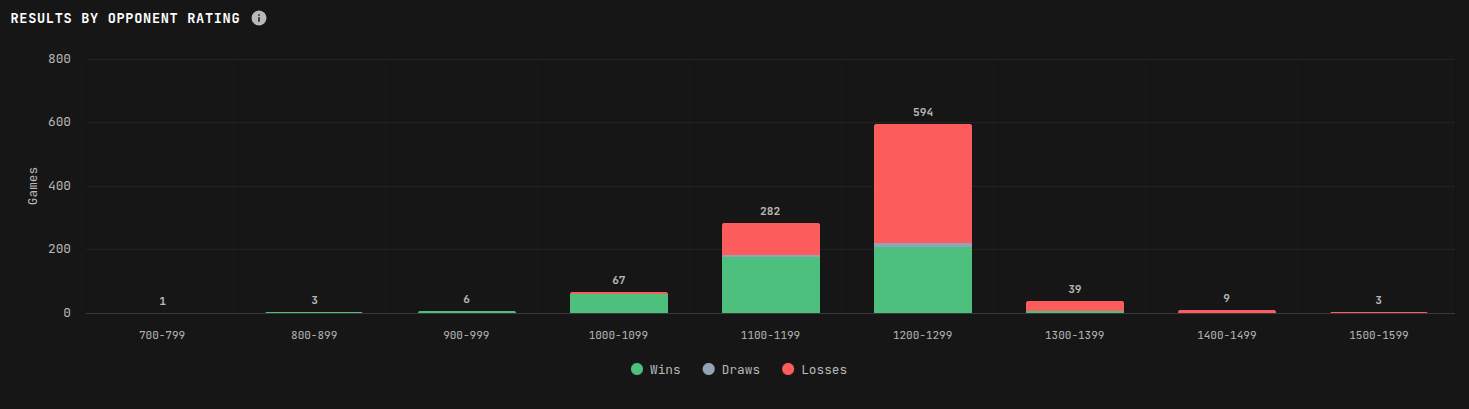
I never noticed when I was playing someone significantly higher, but apparently most of my losses come from those very strong players. I have a hypothesis that I'm better on certain days and times of the day, and I'd like to check that. It might be me and my mental state, or it might be that players of certain strengths also play at different times, but it would be good to know as I used chess games as an indicator of my general focus. When I lost 5 games in a row, I knew my focus was just off that day. It would be good to know if that was real or imagined!
What next?
So that's that I guess. I'm pretty good at chess now. I'm not sure what my next thing will be. Any suggestions?