Bonsai
Overview
I have a number of horticulture-related projects, but this one is probably my most ambitious. I always had an interest in bonsai for a number of reasons:
- Bonsai takes a drip feed of persistent discipline over a long period of time
- Bonsai takes great care and an attention to detail
- Bonsai as an art form has an air of elegance to it
I'm someone who rarely plans for the future. I find it difficult to even imagine the future, beyond being drafted into the Climate Wars. I opt out of pension schemes, don't have any ISAs, index fund investments, or generally bet on the future. I live in the present, always.
There are certain actions that slowly add up over time however. I believe in setting good habits and routines in the present, and enjoying the journey rather than focusing on a future outcome. Bonsai is a great example of this, and a challenge I would like to take on.
Bonsai plants that have been properly taken care of can be quite an expensive item, but I don't think they're worth the effort I would put into them (at best, they would only be worth it at scale). I want to exercise pursuing a meticulous craft over a long period of time, learning about an area I'm interested in, and being the kind of person who would own bonsai plants I suppose.
Knowing about my interest in bonsai, Veronica's mum got me a pretty extensive starter kit for my birthday (2022). I told myself that I'd give it a go once I had seen some success with my tomatoes, but the reality was that I was just procrastinating out of intimidation. A year and a month later (2023), I decided to finally start. The long journey commences!
Amar Memoranda > Bonsai
 Yousef Amar
Log
Greenhouse effect
I moved houses recently. The new place has a conservatory and an outside space. I wouldn't quite call it a garden, as it's paved, however I do intend to get some flower beds for it. I think this will be great for my horticultural endeavours.
The most sensitive items I carried over to the new place in my arms. The first time was with the Luton van drivers in the front, where I carried my bonsai plant. The second time was the final trip over, where I carried Jinn and the ant colony.
My bonsai plant had made it in one piece, and I was glad. However, I then made the mistake of putting it in the conservatory. I did not realise just how hot it got in there. The next day, I found that the leaves on my bonsai plant had gone completely brown and shrivelled.
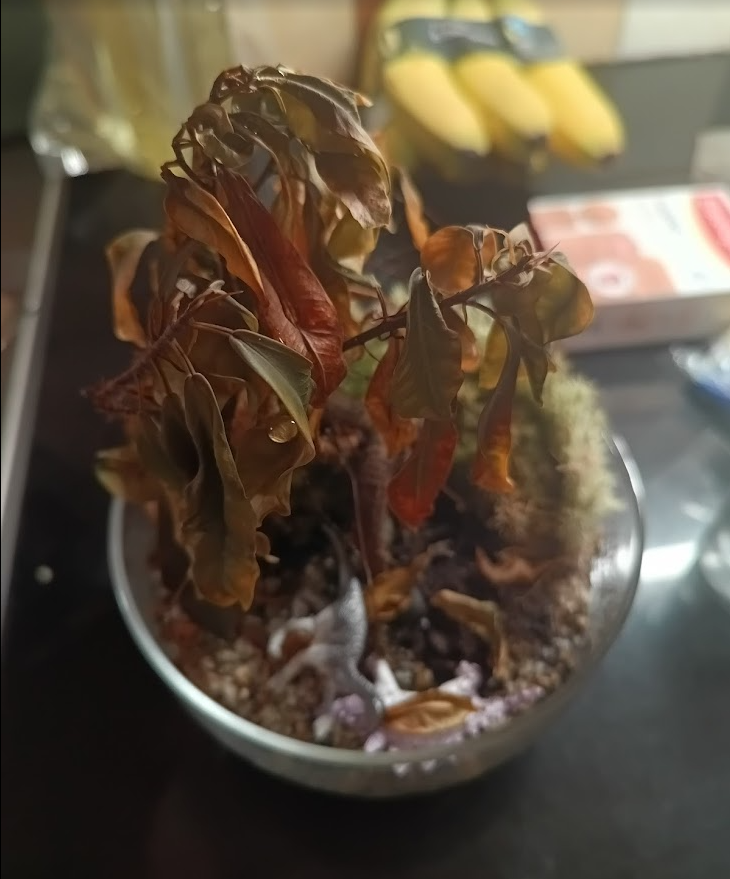
The glass was extremely hot to the touch — almost scalding. I realised I’d essentially cooked the plant. The moss had turned white. I immediately moved it to the cooler kitchen and rehydrated it by adding water.
I think it can bounce back over time, but this definitely is a setback. I'm very glad I didn't move the ants there.
Alien invader prongs
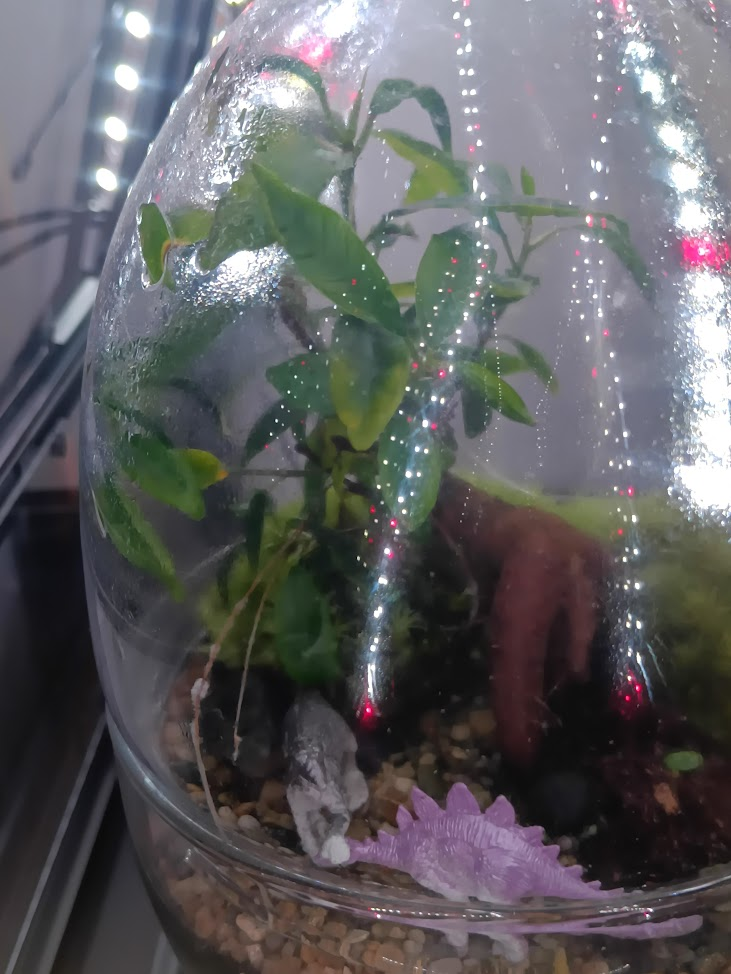
The ficus has been a bit thirsty, as you can tell by the leaves that have shrivelled slightly:
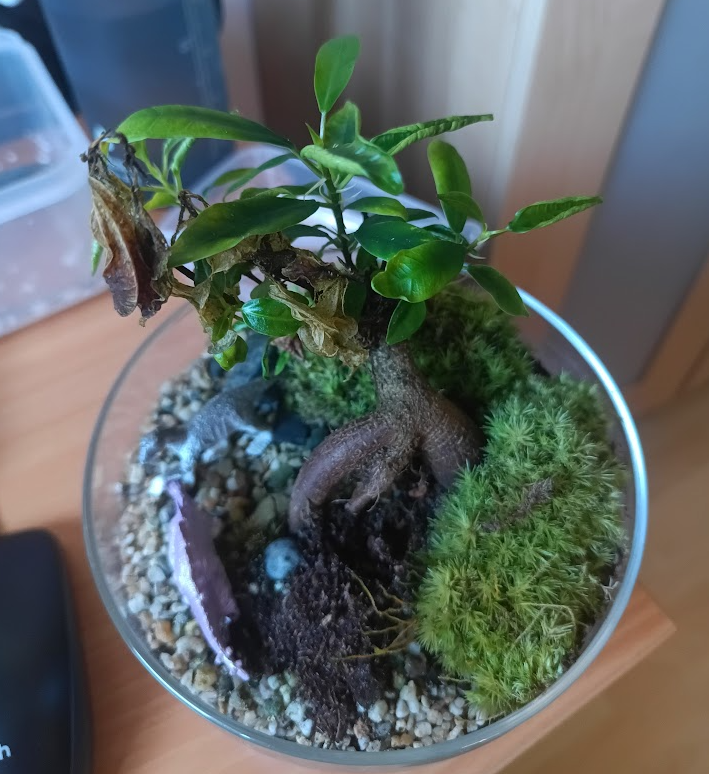
So I thought it's high time to first clean up the dead leaves, and also add water to the terrarium. The moss too seemed to be very dry (and I trimmed some of the long freaky moss prongs). I accidentally cut a little leaf, so I put it back into the soil, however it seems to be immune to decomposition:
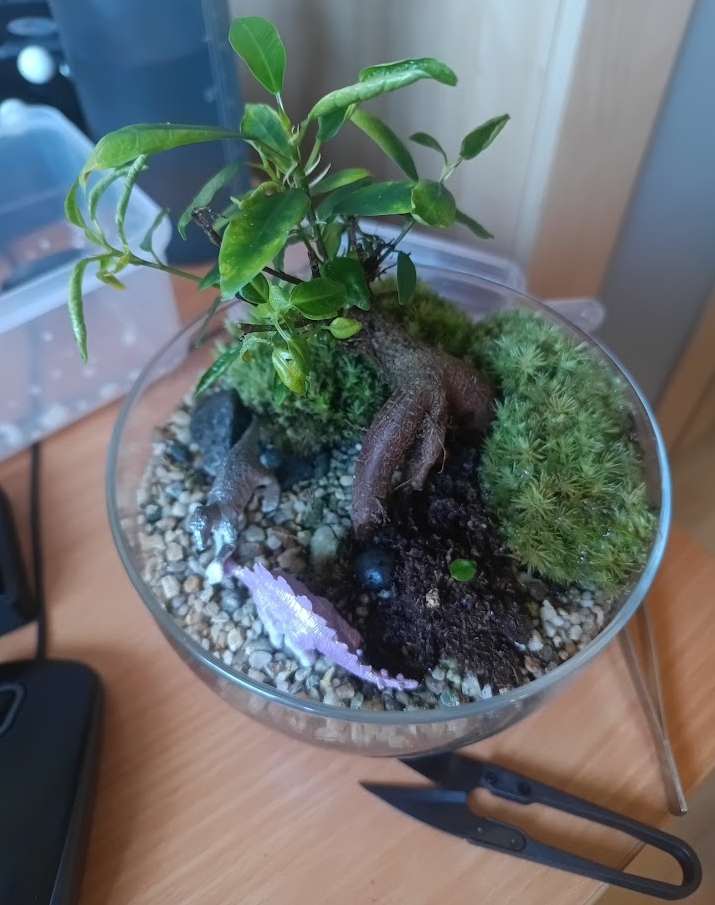
This was all mid-September, and I was a tiny bit freaked out by these additional weird prongs:
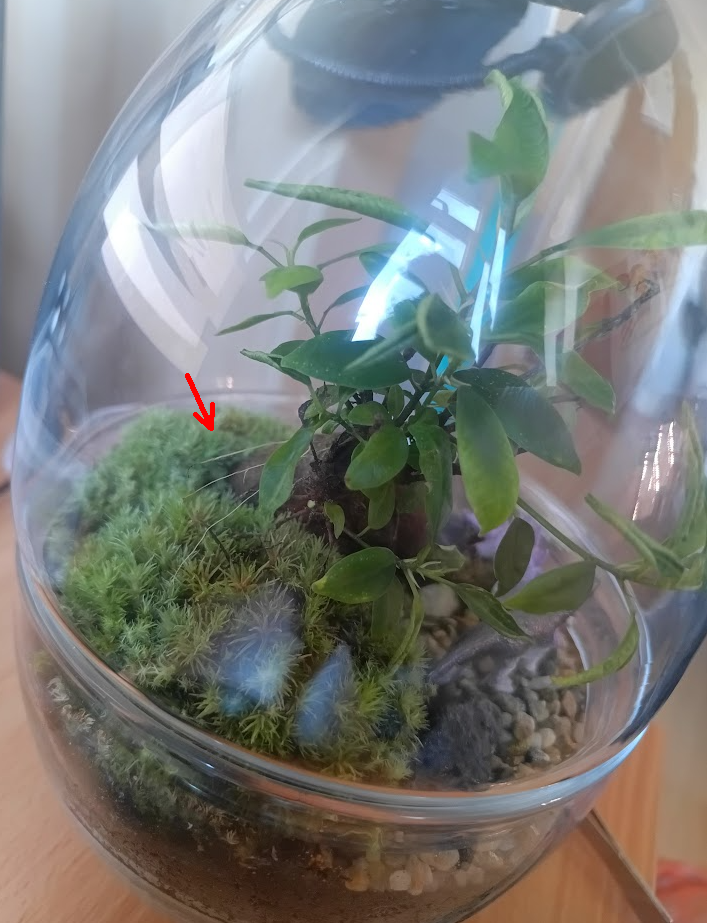
Then, a little over a week ago, it started looking even more alien. The leaves were ok now (some browning?) but now these prongs looked sort of fungal. Don't like it.
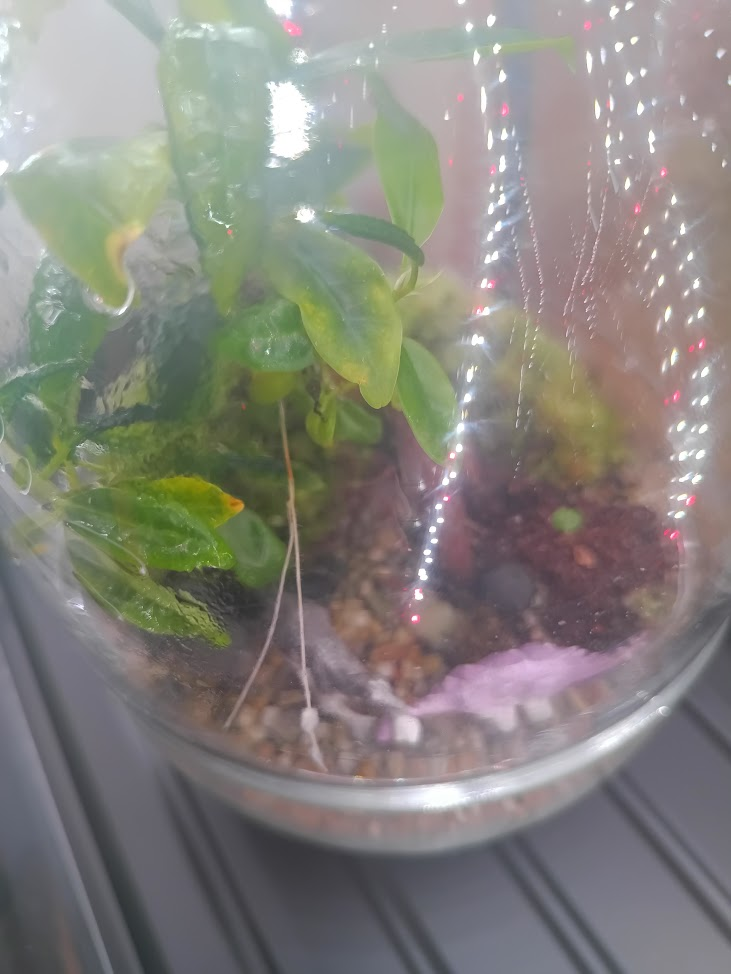
A photo from today; that alien prong has grown further and is reaching the ground. I think I need to snip it before it consumes the terrarium!
Rising from the ashes
It's frightening how close I keep getting to killing my ficus -- they're supposed to be hardy! An update is long overdue.
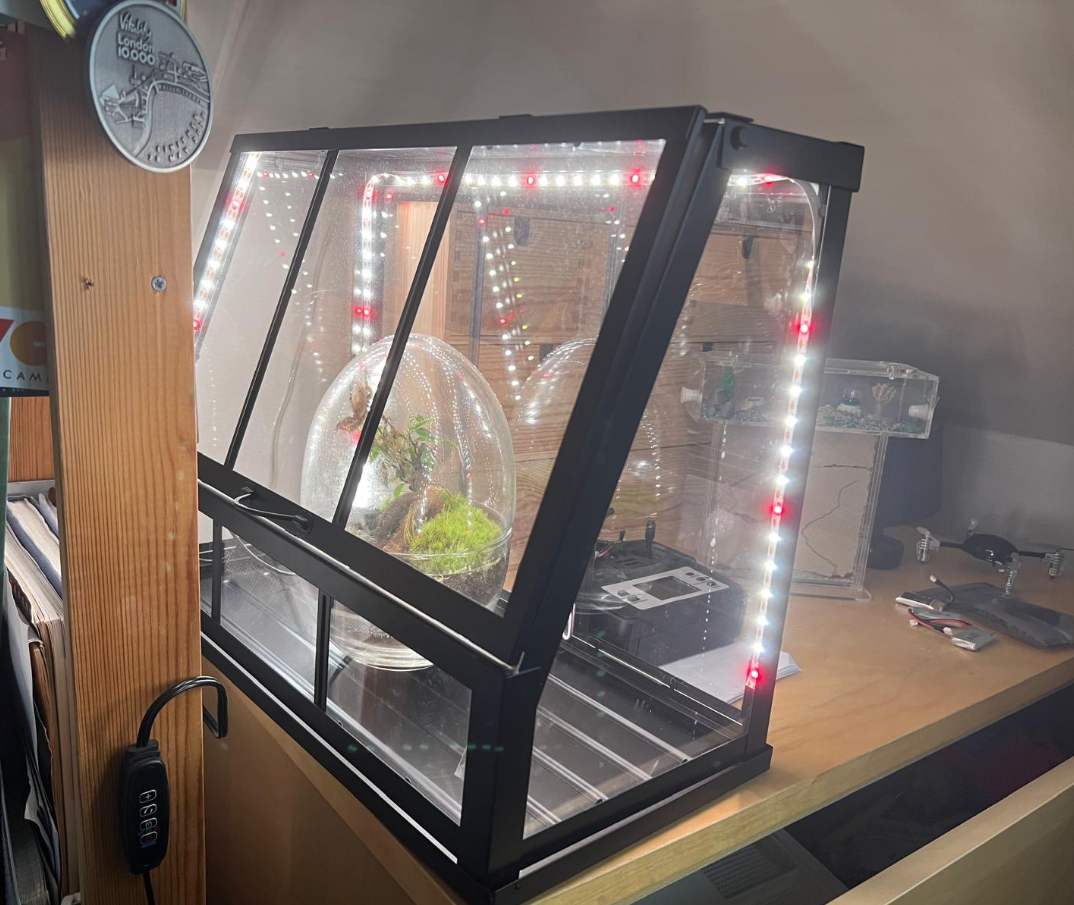
First off, I moved the UV LEDs into an IKEA greenhouse. This made things much tidier and I have room for the upcoming project. The ficus had some strong growth up and to the left, all but touching the glass.
I also got these wooden drawers that you can kind of see in the back, with each one dedicated to a different project. The bottom one (taking up the whole width) is the horticulture one as that needs the most space.
Early May, I noticed that the leaves were getting brown. I thought it might be because the humidity is too high, so I thought I'd air it our a bit. Overnight it shrivelled up completely.
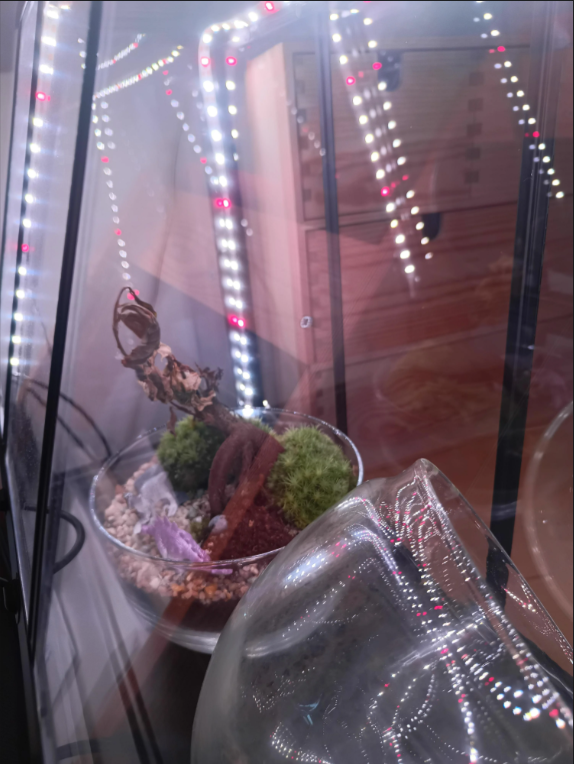
I was heartbroken and went to /r/Bonsai for advice. The only response I got was "it dried out and died". I did my best to try and get the humidity right and crossed my fingers. Almost two weeks later, I was delighted to see that it was still alive and had sprouted a new leaf! Can you see it?
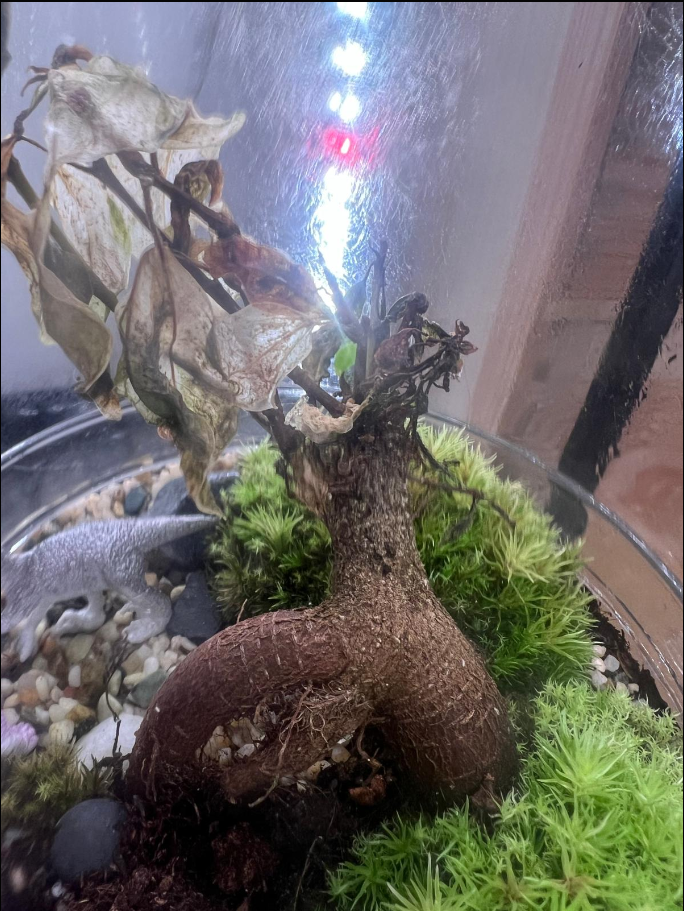
And now, two months later, look at all this foliage!
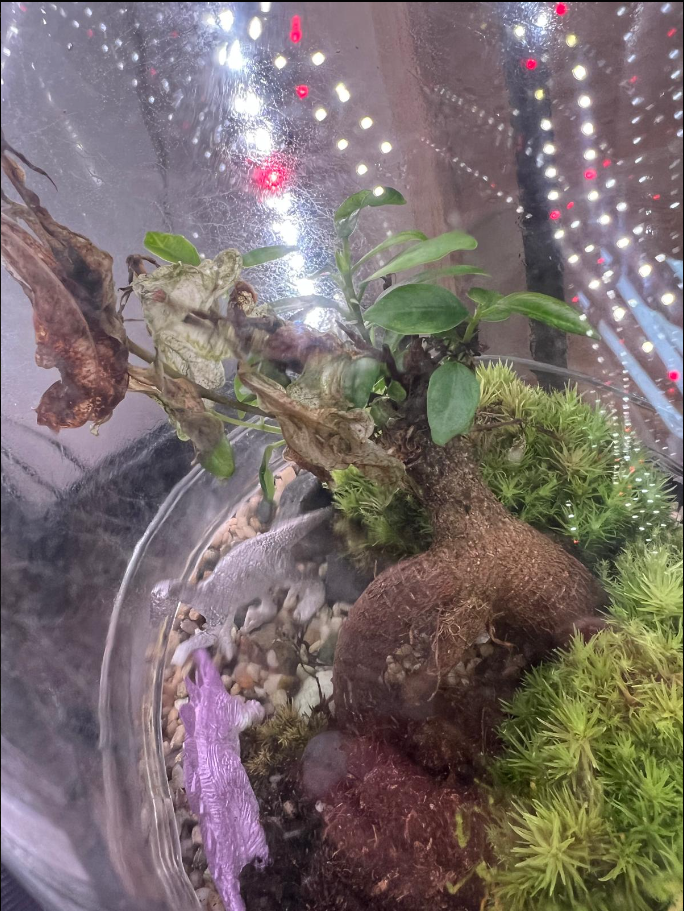
I do plan to remove the dead leaves, but I wanted to wait for it to be a little stronger before I remove the glass again and whack things out of balance.
Ficus rollercoaster
I recently wrote about my ficus terrarium and how some kind of mould defeated my fittonia. Since then, I've learned a lot more about terrariums (including learning about ones where you keep frogs and reptiles, from a very friendly pet shop employee). The ficus however, which is meant to be quite hardy, did eventually have the same mould problem.
By early January, it was getting quite dire. No matter how much I tried to control the humidity, the leaves were all dying and there was thread-like mould forming like spider webs. I don't think I took a photo of this.
I did some more research and found a potential solution: little creatures called springtails (this was later confirmed to me by friendly pet shop guy). I ordered live Springtails off of Amazon (I didn't know you could do that) and they arrived quite quickly.
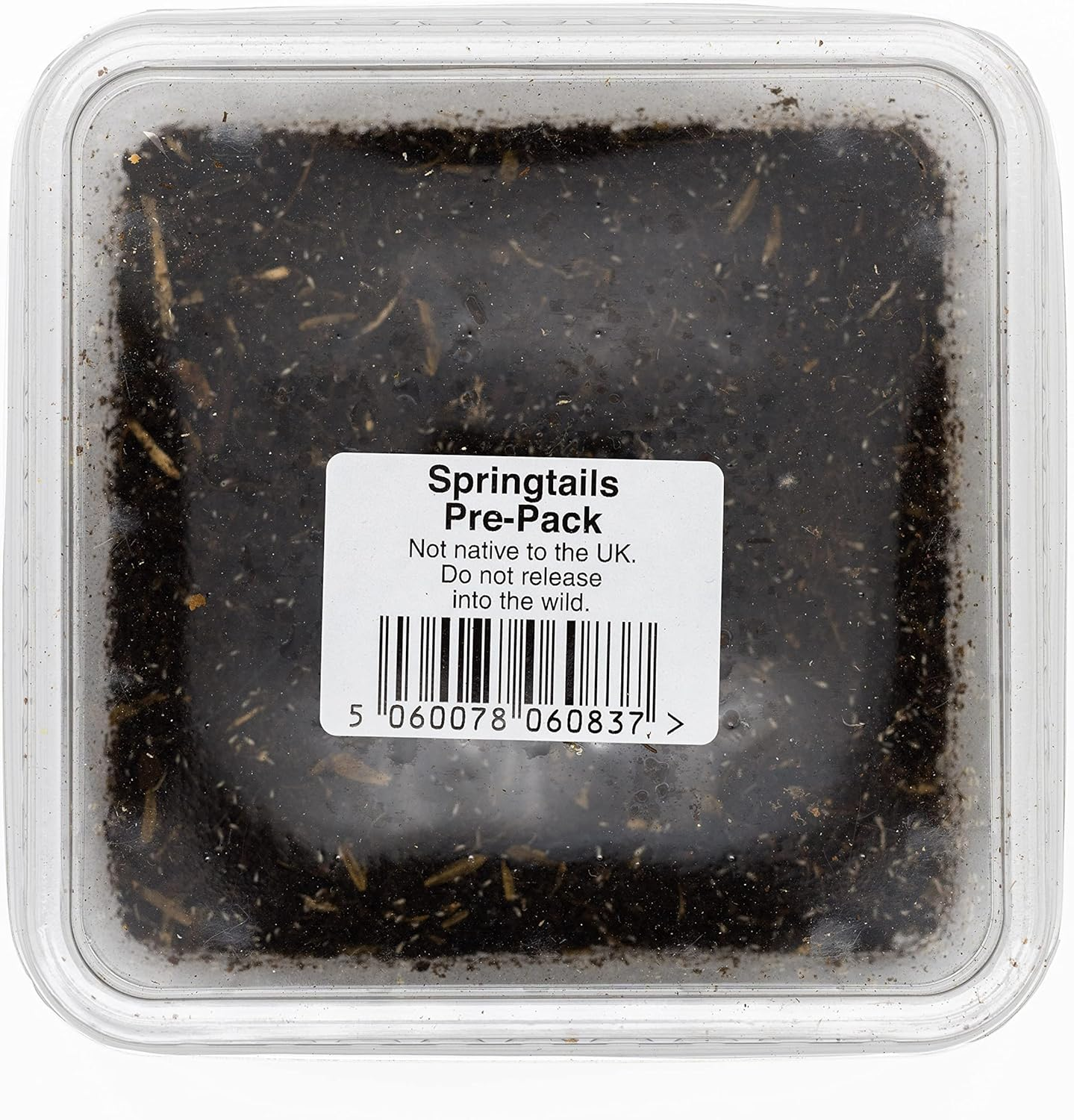
They arrive in some soil. The cardboard box they arrived in was smaller than the plastic container, so the act of squishing the plastic container into that box had caused it to open. It was kind of a messy situation. Regardless, I introduced them into the terrarium, slowly adding more over time. They're kind of hard to see with the naked eye, but if you really focus you can see them crawling around. They can also jump, which to me looks like they just disappear.
Fast-forward to today... it worked! They cleaned up the mould on the glass as well as the white threads that were attacking the plant. They seem to fit well into this ecosystem! I still have the container with the rest of them, which I might have a future use for (hint: my ant farm I will write about soon).
I am glad to report that new leaves have sprouted, and the health of the ficus looks like it's slowly improving!
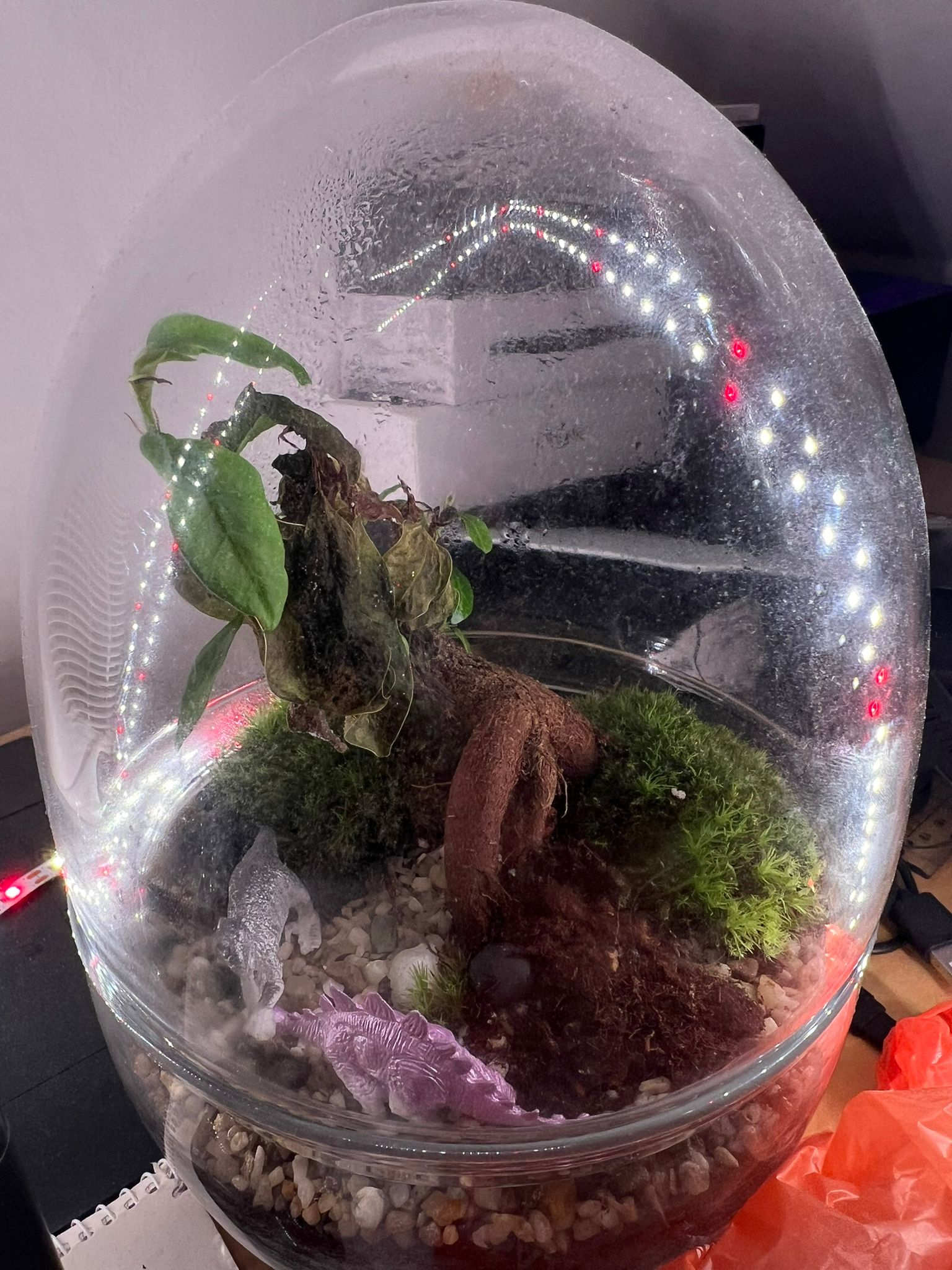
Stay tuned to know more about my horticulture adventures, including a new plant project that I will write about soon! Hint:
Ficus in a glass egg
I was recently offered condolences when someone found out about the unfortunate fate that befell my Bonsai plant. There's a small update!
A little over a month ago, Veronica and I went to a terrarium workshop and put together a little home for a little ficus. They're very hardy.
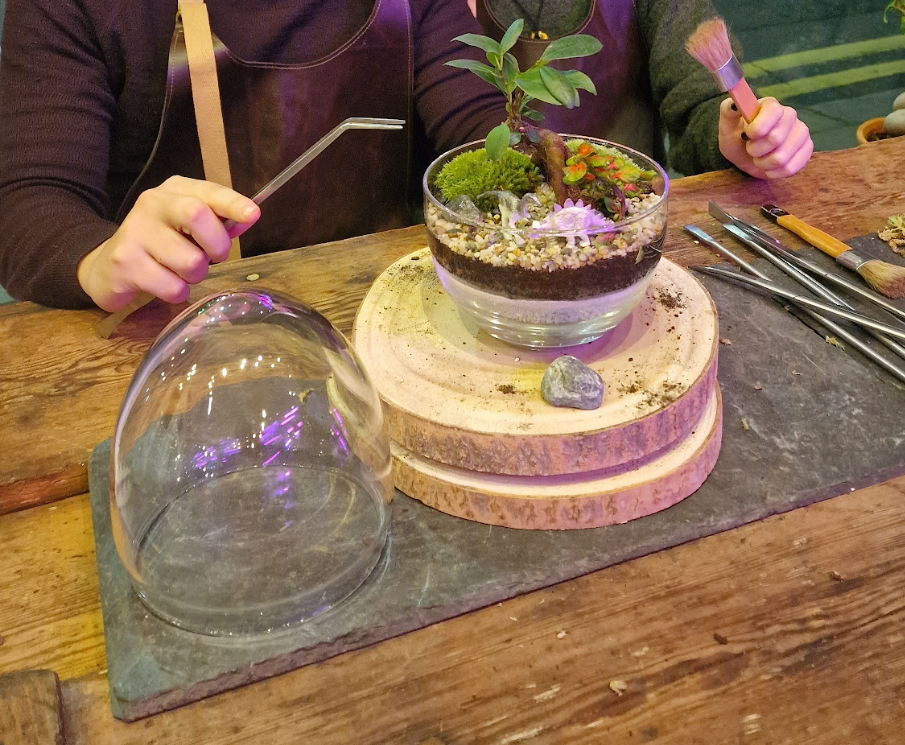
I picked everything out down to the colours of the sand layers and we carefully placed and aligned everything. It's not just pretty, but everything has a function. For example, the moss tells you when when it's time to add (distilled!) water, the large rocks can provide a surface for that water to evaporate (rather than get absorbed by the moss). We also added two dinosaurs, one patting the head of the other one.
As hardy as the ficus is, unfortunately the fittonia in the back was a lot more temperamental. I thought it maybe couldn't handle the humidity (the guides said you shouldn't let too much condensation build up on the glass) or it needed more light. It unfortunately started getting these strands of mould and eventually became a gloop.
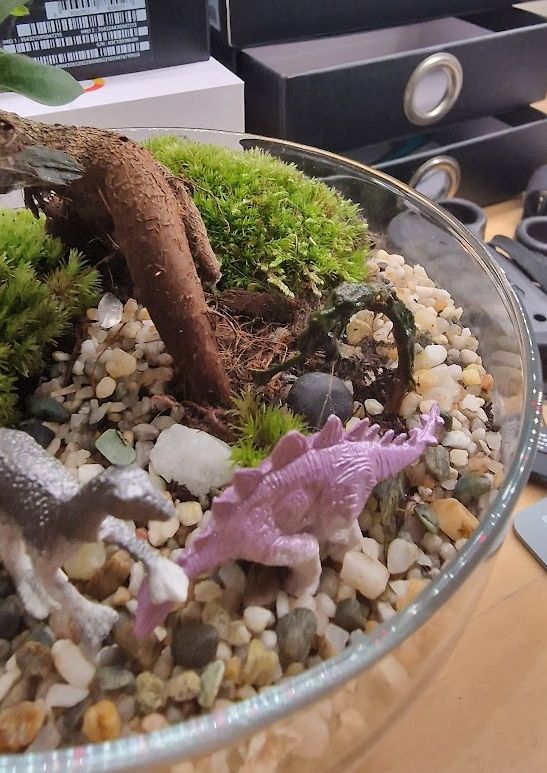
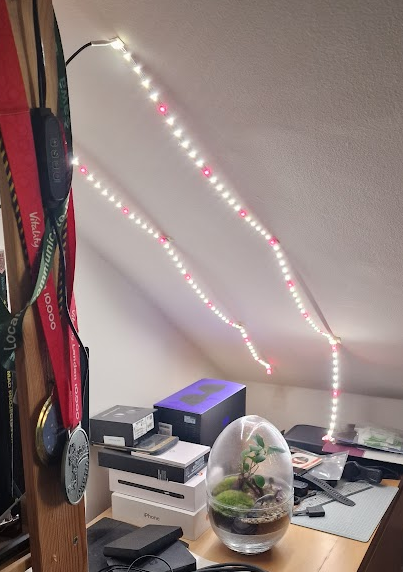
I called the workshop instructor and he said there may be a number of reasons for this, asked for photos to troubleshoot, and he offered to replace it if I came by, but Shoreditch is kind of a trek from here. He said I should take it out so that it doesn't damage the ficus. In the meantime, I also got some grow lights so I can have a bit more control over the environment, rather than be at the mercy of UK winter weather!
Disaster has struck
Towards the end of August, I went to visit my mum in Germany. Veronica would take care of my bonsai plant in my absence. One day she woke up to a gruesome murder scene (warning, graphic images to follow).
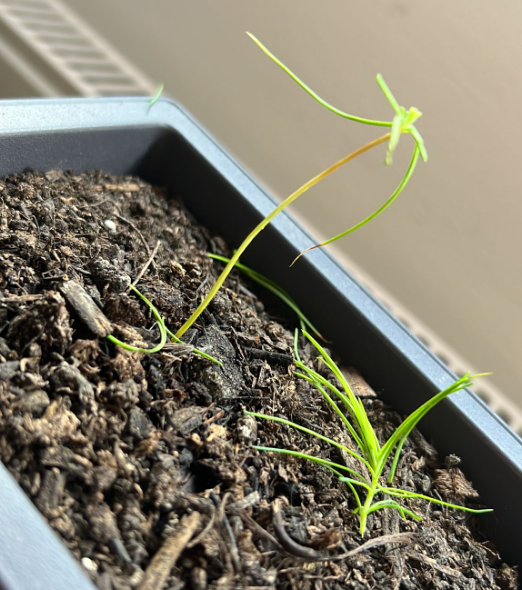
Veronica thought it got too top-heavy and broke, but Black Pine saplings don't just explode like that. I knew it was our cat Jinn. In a bunch of further images, I noticed what look like nibble marks too. I know she likes to nibble on grass too. I insisted that she immediately tell the cat off and show her what she did wrong. Cats are not that smart and won't be able to connect consequences to their actions unless they're tightly associated. In my opinion, Veronica is consistently too soft on the cat.
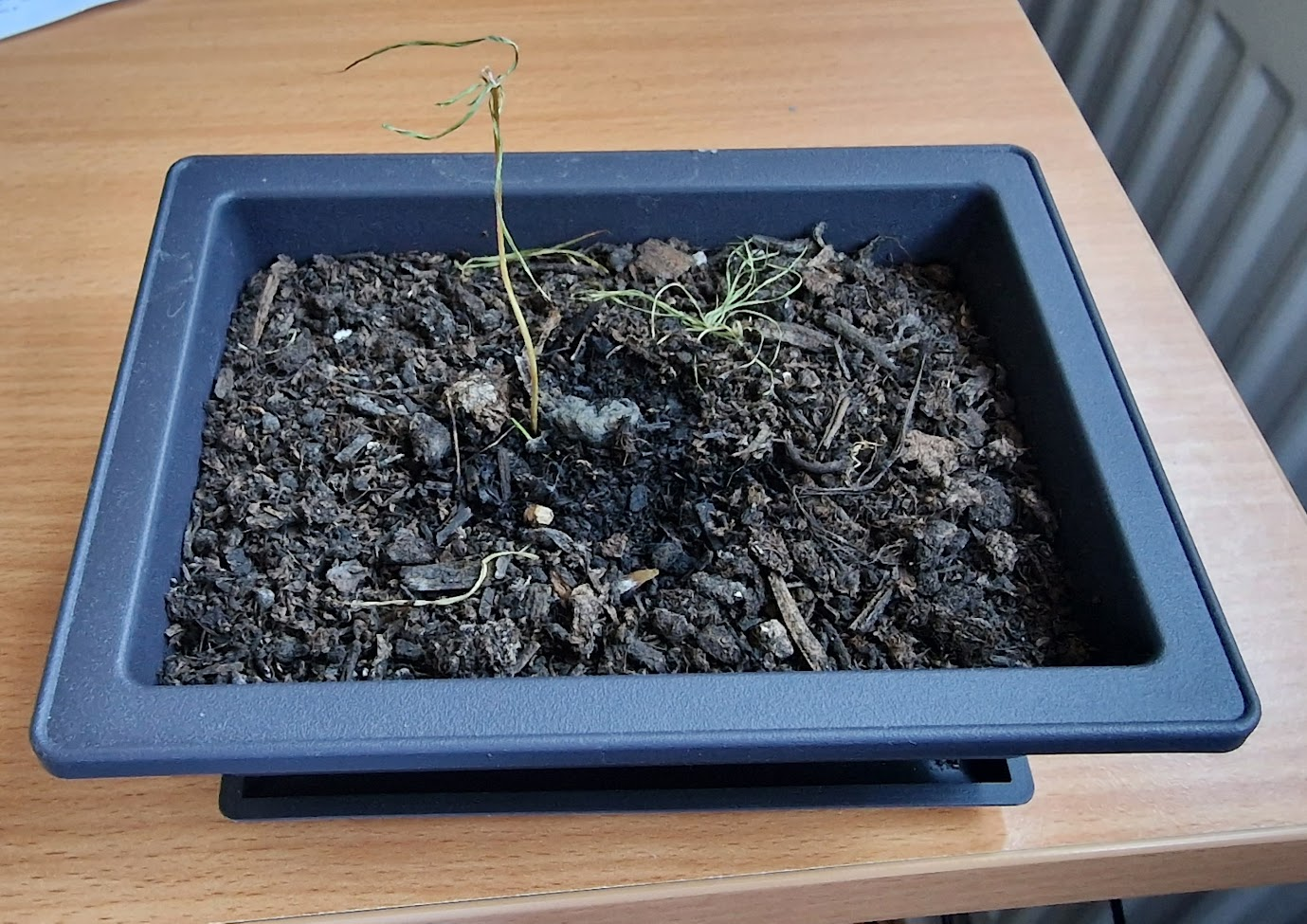
Veronica felt bad about the death of bonsai buddy (although she insists it can still be saved) but it seemed to me a 10 year journey was cut prematurely short. There's not much that can be done in my opinion except starting over. Since I've been back, I've been seeing if it can be saved, with not much success yet. This is what it looks like today:
When I came back, Jinn was very misbehaved for a bit. She knows she's not allowed to jump on my desk -- twice I caught her doing so and sniffing the bonsai corpse while she thought I was asleep. She knows that certain other areas are out of bounds for her, and she was pushing those boundaries. It took her a week or two of me being back for her to go back to normal and for us to be friends again.
R.I.P. bonsai buddy
Bonsai diversification
My Red Maple and Wisteria seeds haven't sprouted yet, but I was left with all this extra soil! So I decided that I ought to plant the other species too. The remaining seeds I have are for Black Pine, Cherry Blossom, and Japanese Cedar. This is what they look like respectively:
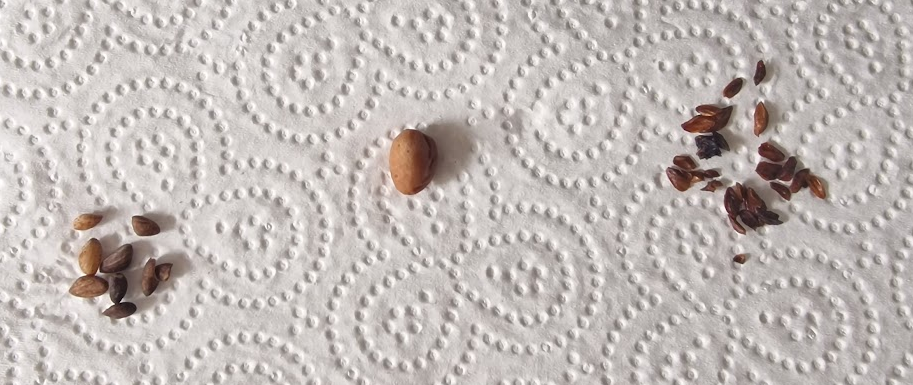
I only had three Cherry Blossom seeds, and unlike the Red Maple, I decided to only plant one seed in that pot. Besides that, I've largely only used half of the seeds I have of each species so far, and I'm thinking that even that is unnecessary, but let's see!
As I was soaking them for 48 hours, they kind of got mixed up a bit, and I had a bit of a challenge separating the Black Pine from the Cherry Blossom, but I think I got there in the end. To better keep track of everything, as I was really starting to forget which is which, I put in some little wooden sticks:
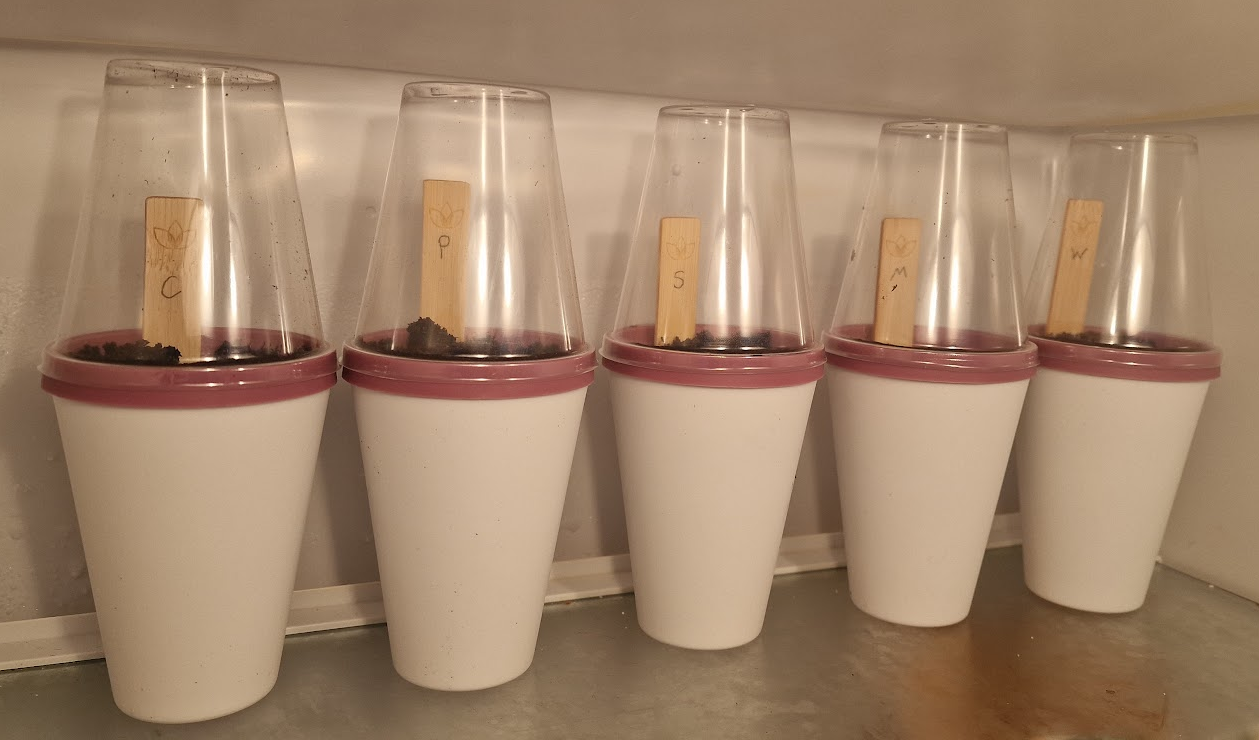
The soil had dried quite a bit, so I made it wetter, maybe even a little too wet, as it was soaking the cotton on the bottom and created some condensation on the plastic. I also used tap water, which I didn't do for the first two, as it's pretty hard / rich in calcium. For my tomato plant, the effects of this were soon obvious as calcium residue was visible on the top of the soil and edges of the soil where it meets the pot. I didn't want to have the same for these plants, but it should hopefully all be OK.
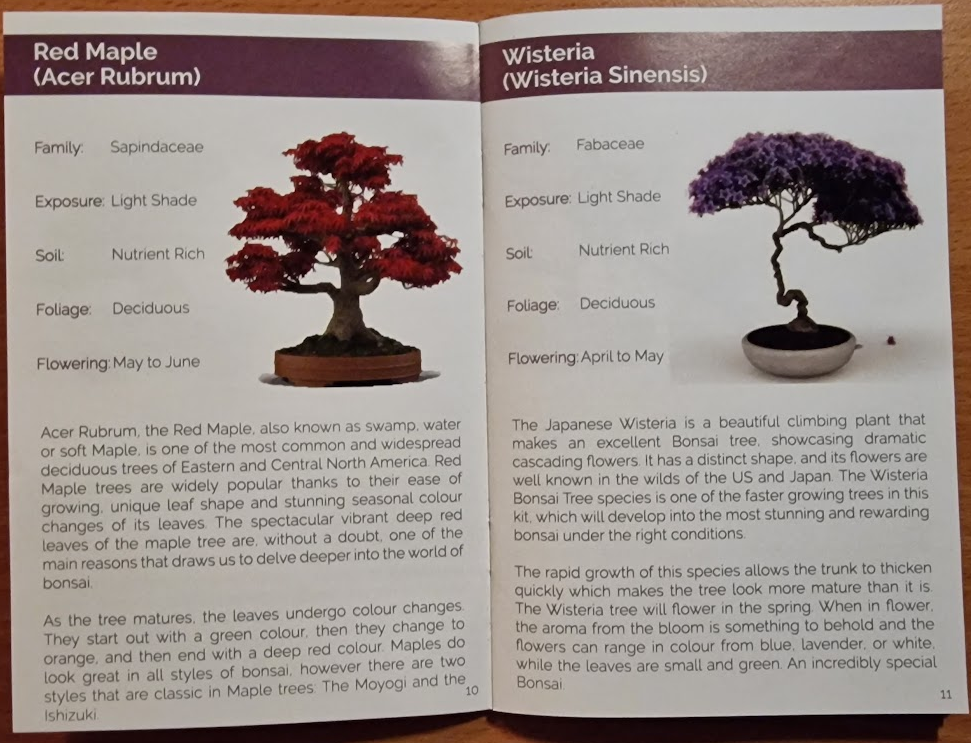
If you'd like to learn some more about each species, here are their sections in my little book:
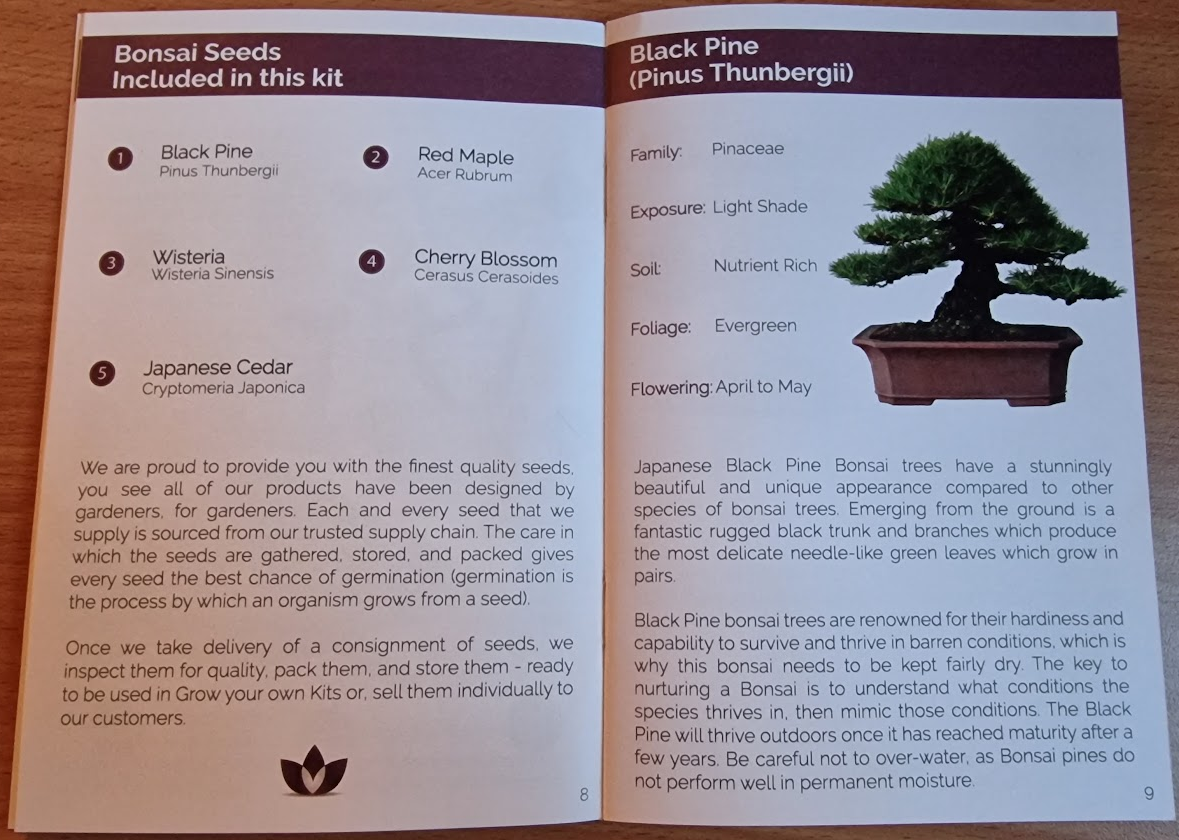
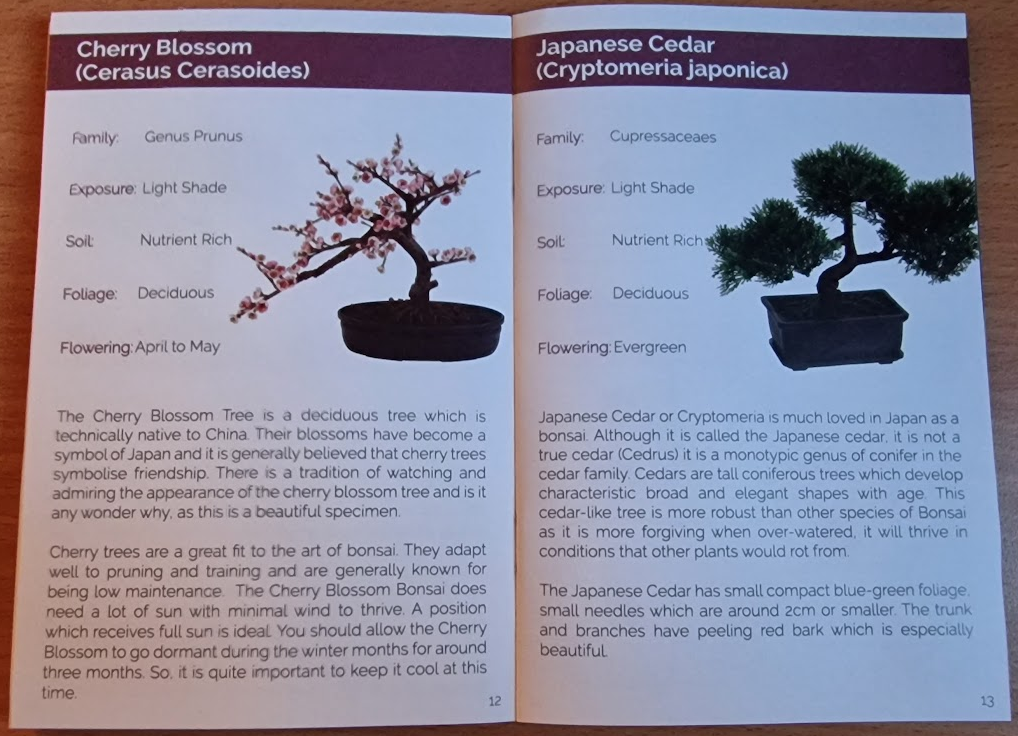
So now we have 5 different pots stratifying -- let's see which sprout first!
Bonsai sowing and stratification
My bonsai seeds have soaked for 48 hours and I'm ready to move on to the next step! The reveal: I picked Wisteria and Red Maple. They ticked all the right boxes for me as my first try.
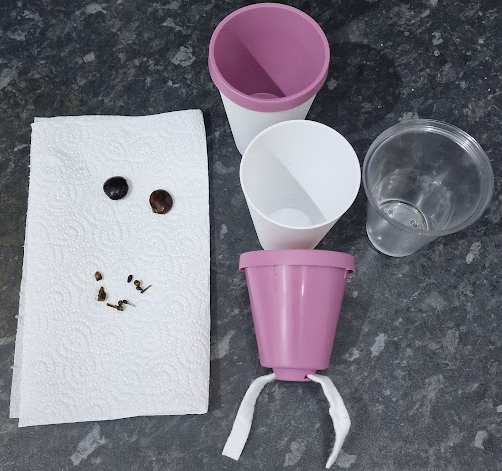
The Wisteria seeds are the small ones and the Red Maple are the two big ones. I used half of the seeds that I had of each species.
I assembled the "Auto Irrigation Growing Pot" and tried to ignore the conflicting instructions. I think you're not meant to fill the reservoir with any water at all until after the Stratification step (which I'll explain in a sec), and it's ambiguous how deep the seeds should go beyond "same depth as the size" (the size of what, the seeds?), so I just used my best judgement.
It turns out that I actually have a lot of soil. I didn't even use up a full peat disc so far. I have three more pots, so I'm considering getting some more seedlings started in the meantime and increase the chances of success...
At any rate, I sowed the current seeds and sprinkled a tiny bit of water into the soil to keep it moist, as it had dried out a bit in the meantime. I don't think the instructions should have the soil bit as step 1 if you're then going to soak the seeds for 48 hours after that, it should really be the second step.
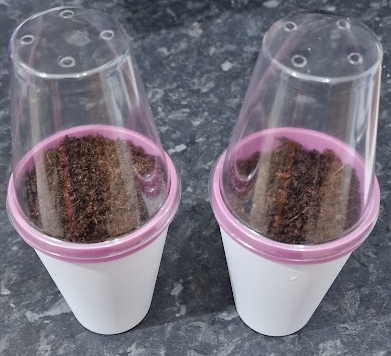
And now that they're sown, I put them in the fridge. In the fridge, the one on the left is the Red Maple (this is more of a note to myself -- I should label them really; there are little wooden sticks for that in the kit). Putting them in the fridge is the first part of the Stratification step, which is meant to simulate winter conditions, then spring, so that they can germinate as they would in nature.
I'll be checking on them every few days and keeping the soil damp. Hopefully in two or three weeks they will start sprouting and I can remove them from the fridge. I set some calendar events. So now we wait!
Banzai, bonsai!
I finally decided to start on my bonsai project. To read more about what this is all about, check out the project page. I haven't written anything about the tomato project, or any of the other (failed) horticulture projects, but I will eventually, since documenting failures is important too! This is the first log of what is probably going to be rather perennial chronicles.
The kit that I'm using to get a start with bonsai is really quite neat. It comes with 5 different species of seeds: Japanese Wisteria, Cherry Blossom, Japanese Cedar, Red Maple Tree, and Black Pine Tree.
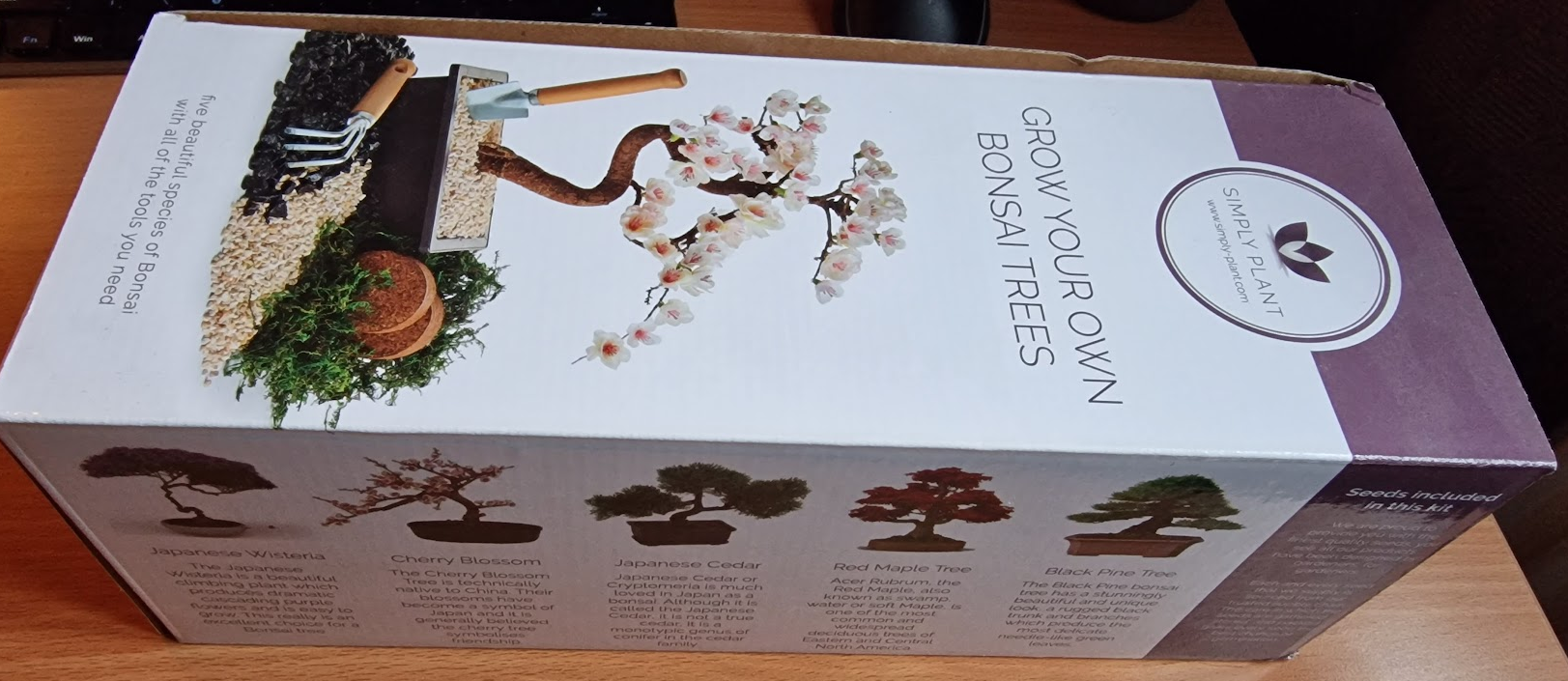
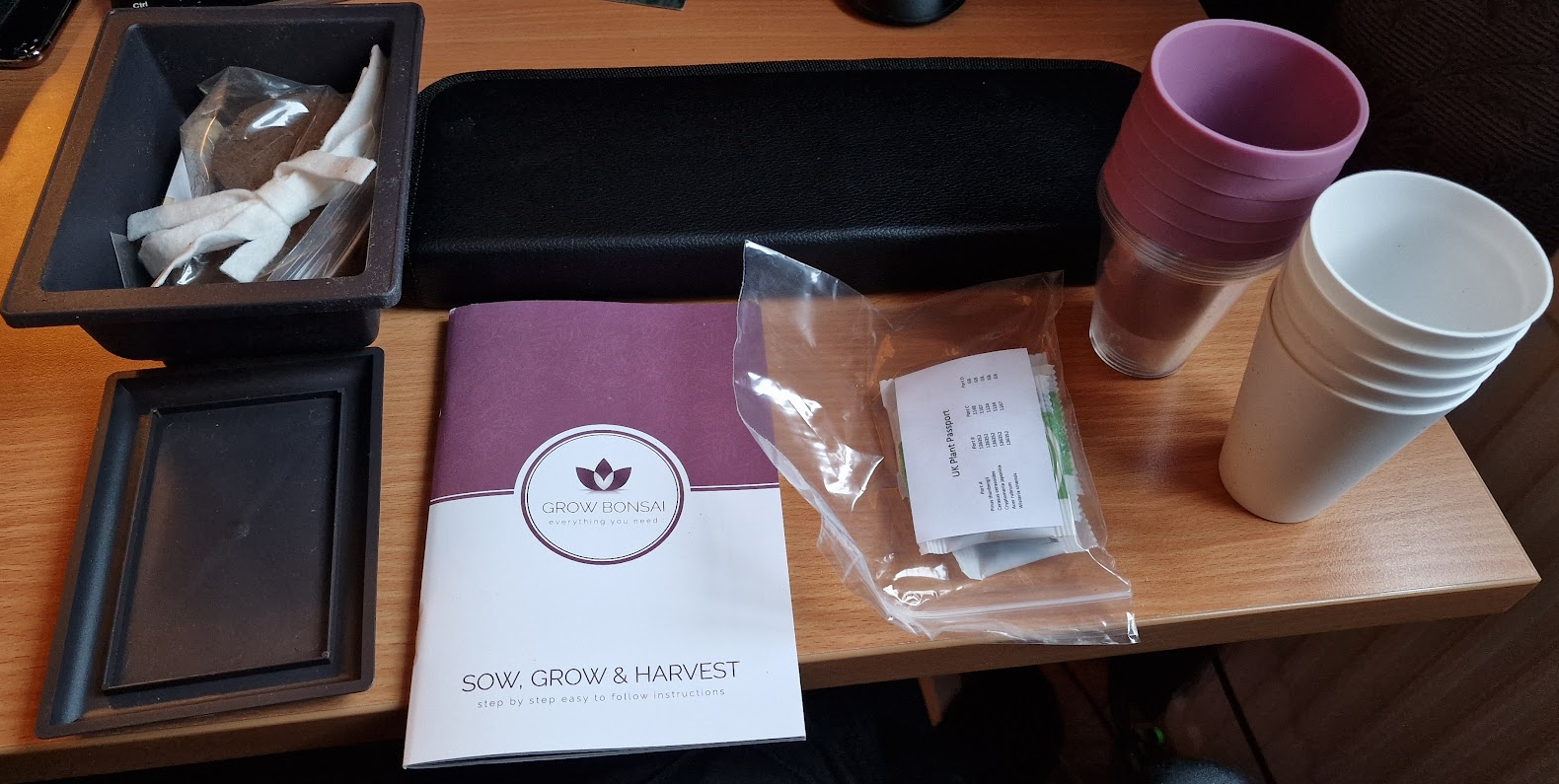
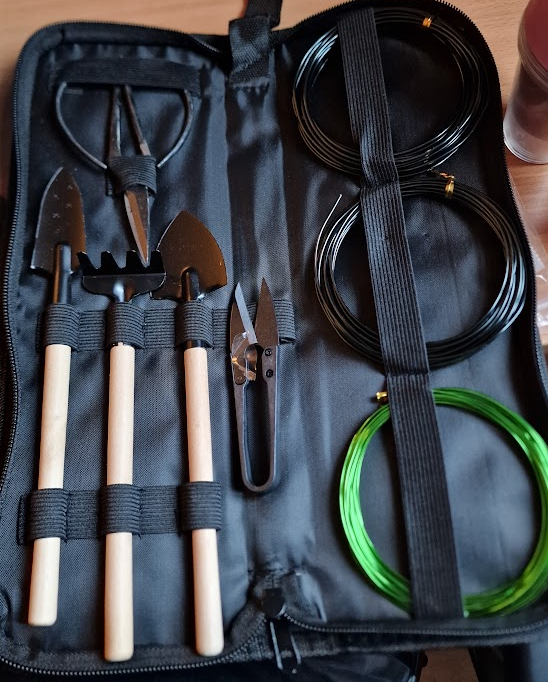
This is a great set of tools in such a small package and I'm quite excited! The instruction booklet goes into a decent amount of detail, though I already know a bunch from YouTube and other places as I had a general interest in bonsai before deciding to try myself.
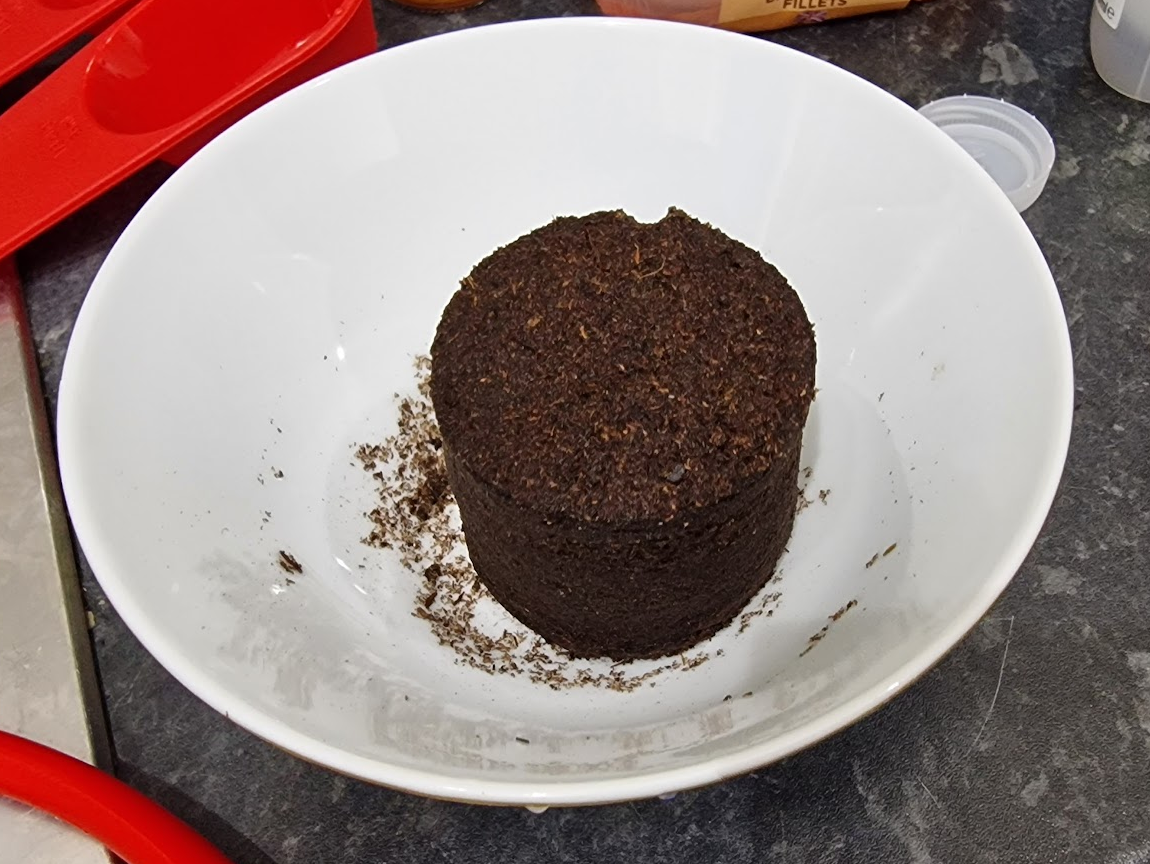
It came with two peat pucks that you put in some water and watch as they slowly grow while they absorb the water.
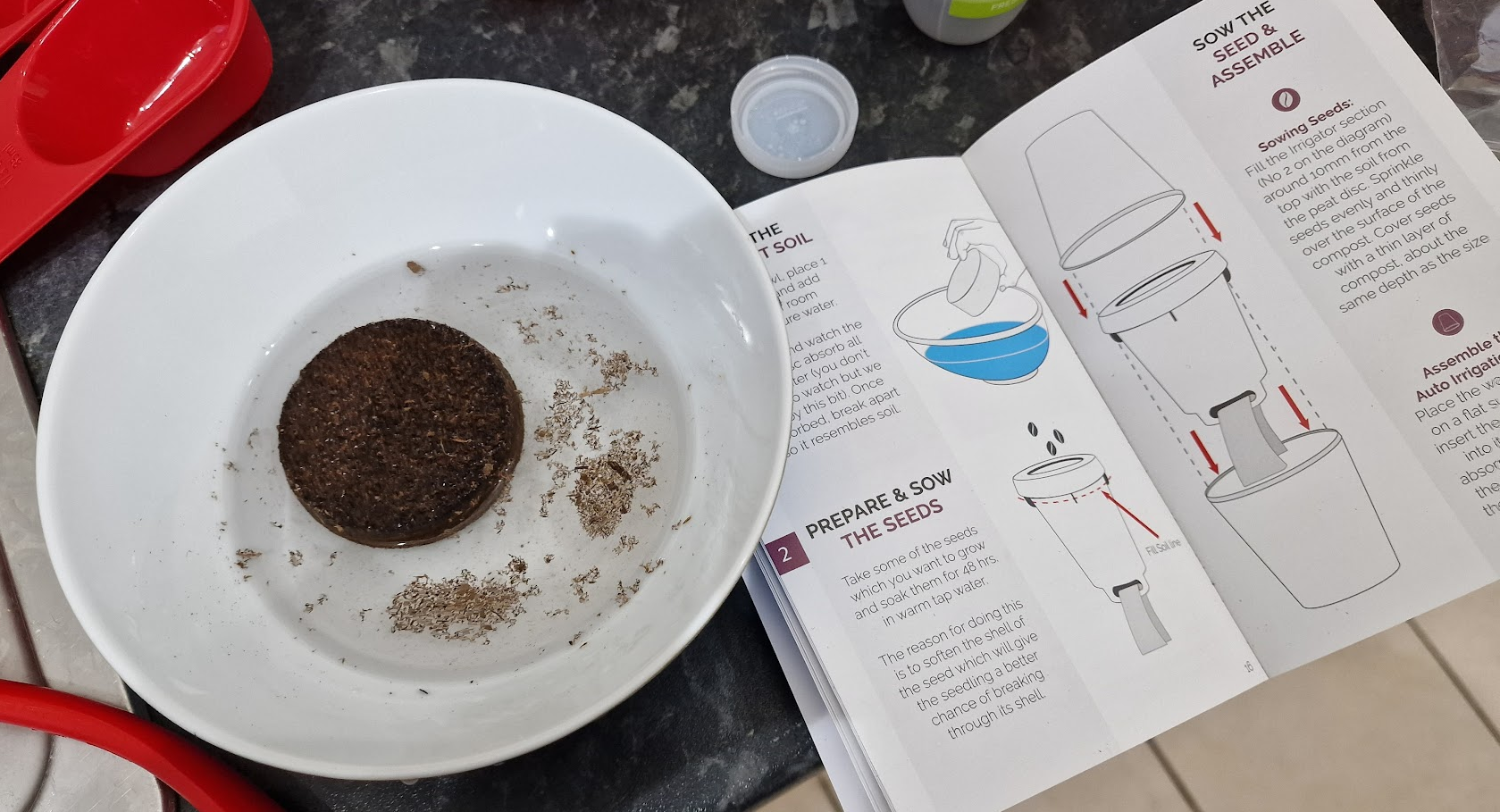
I decided to do both of them, as I wanted to try multiple species at the same time, and they grow to about 3x their original size! It's actually quite a lot of soil.
I then decided on two species that I wanted to grow. The next step was to put some of the seeds in warm water for 48 hours, such that they can soften, which makes it easier for the seedling to break through the shell. The two that I picked had seeds that looked very distinct from each other!
If you would like to know what species I picked, check back in 48 hours when I document the sowing process! I'll give you a hint: I didn't pick the mainstream choice (Black Pine).